
Invention Patent Granted in China for an Antifouling Ultrafiltration Membrane
On 25 September 2026 the China National Intellectual Property Administration granted invention patent ZL 2023 1 0006600.8 to Guangdong Orange Filtration Technology Co., Ltd., under certificate No. 9304022 and grant publication CN 116212650 B. The application was filed on 4 January 2023. The subject is a method for preparing an antifouling ultrafiltration membrane. The named inventors are Zhigang Wu and Pei Li.
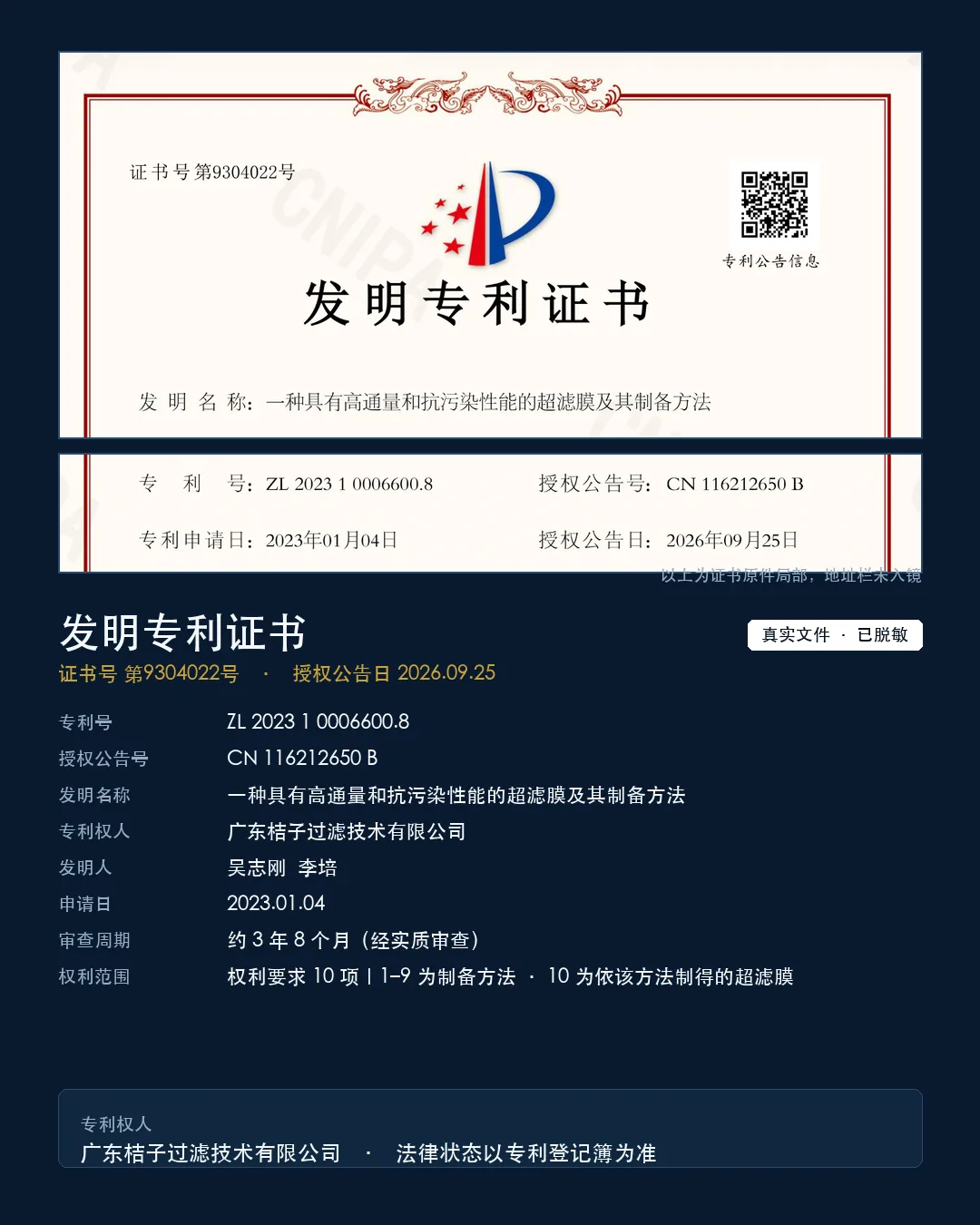
"Invention" is the word that carries weight
Chinese patent law recognises three types: invention, utility model and design. Only the invention patent undergoes substantive examination — an examiner searches the prior art and rejects claims that do not clear it. A utility model is registered, not examined for inventive step, which is why a customer’s engineer treats the two differently.
This is the only invention patent in our portfolio; the rest are utility models and designs. We draw the distinction because a supplier who cannot say which kind of patent they hold is usually holding the kind that does not need explaining.
The problem: both common routes give something back
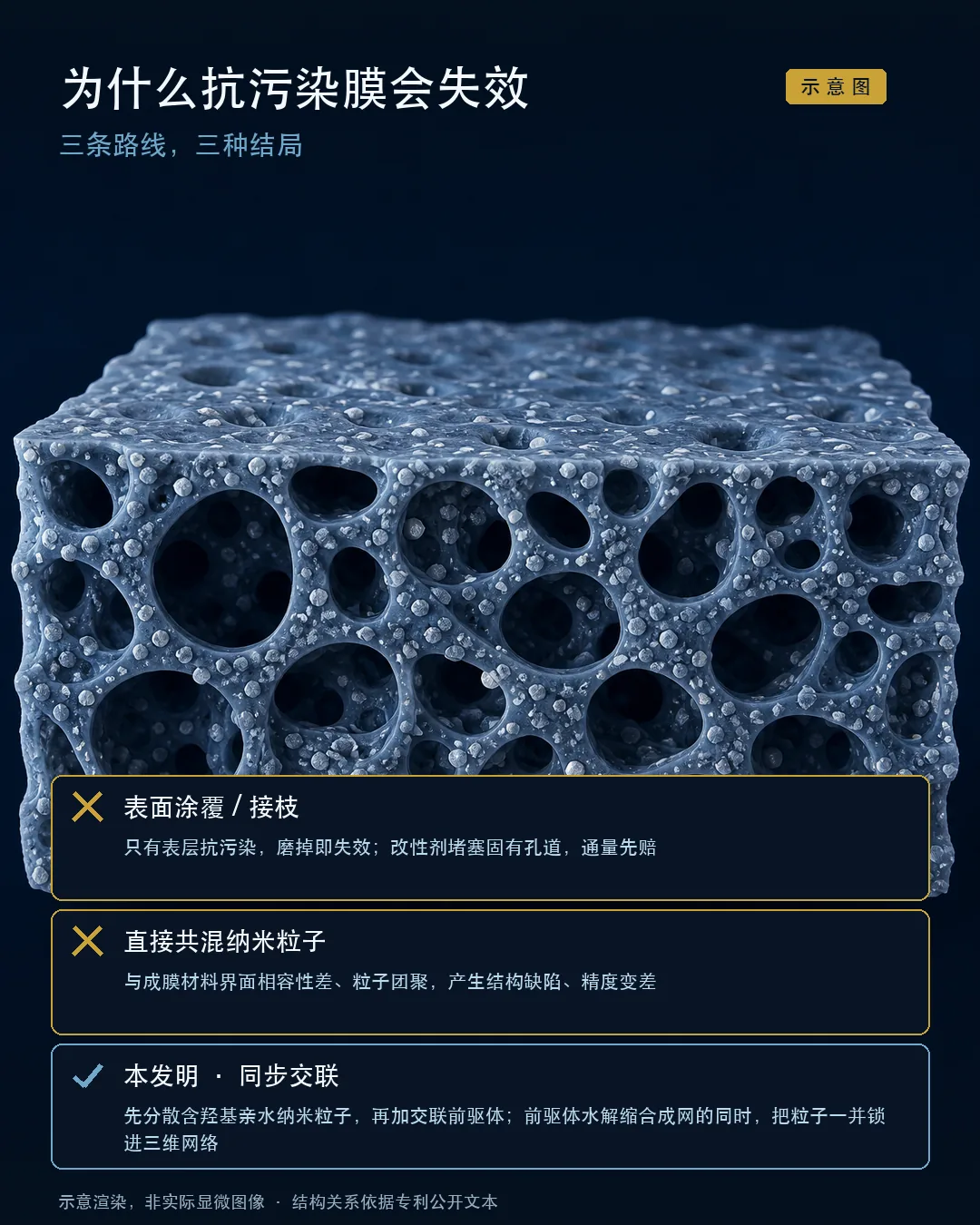
Making a membrane resist fouling means getting hydrophilic particles into or onto the pore wall. Two routes dominate, and each pays for the benefit somewhere else.
- Surface coating puts the function where it wears. Every backwash and every cleaning cycle thins the layer — and a coating thick enough to survive tends to cover pore openings, so antifouling resistance is bought with flux.
- Direct blending mixes the particles into the dope before spinning. Hydrophilic nanoparticles do not stay apart in that mixture: they agglomerate, and every agglomerate is a defect that costs precision.
Both fail for the same structural reason — the functional additive and the membrane matrix are made separately and then forced into contact, so the bond between them is mechanical, and mechanical bonds are where performance leaks.
What the patent changes is the order of addition
The claimed method reverses the sequence. The hydroxyl-bearing hydrophilic nanoparticles are dispersed first; the crosslinking precursor is added afterwards. As the precursor hydrolyses and condenses, it builds the polymer network around the particles and locks them into it while that network is still forming.
The functional component is therefore distributed through the full thickness of the pore wall instead of sitting on the surface as a skin. There is no layer left to wear off, and no pre-existing agglomerate waiting to become a defect.
Claims 1 through 9 cover the preparation method. Claim 10 covers the ultrafiltration membrane produced by it — the protection reaches the product, not only the process.
What the specification measured
The granted text contains a comparison table. We reproduce it because a mechanism without numbers is marketing.
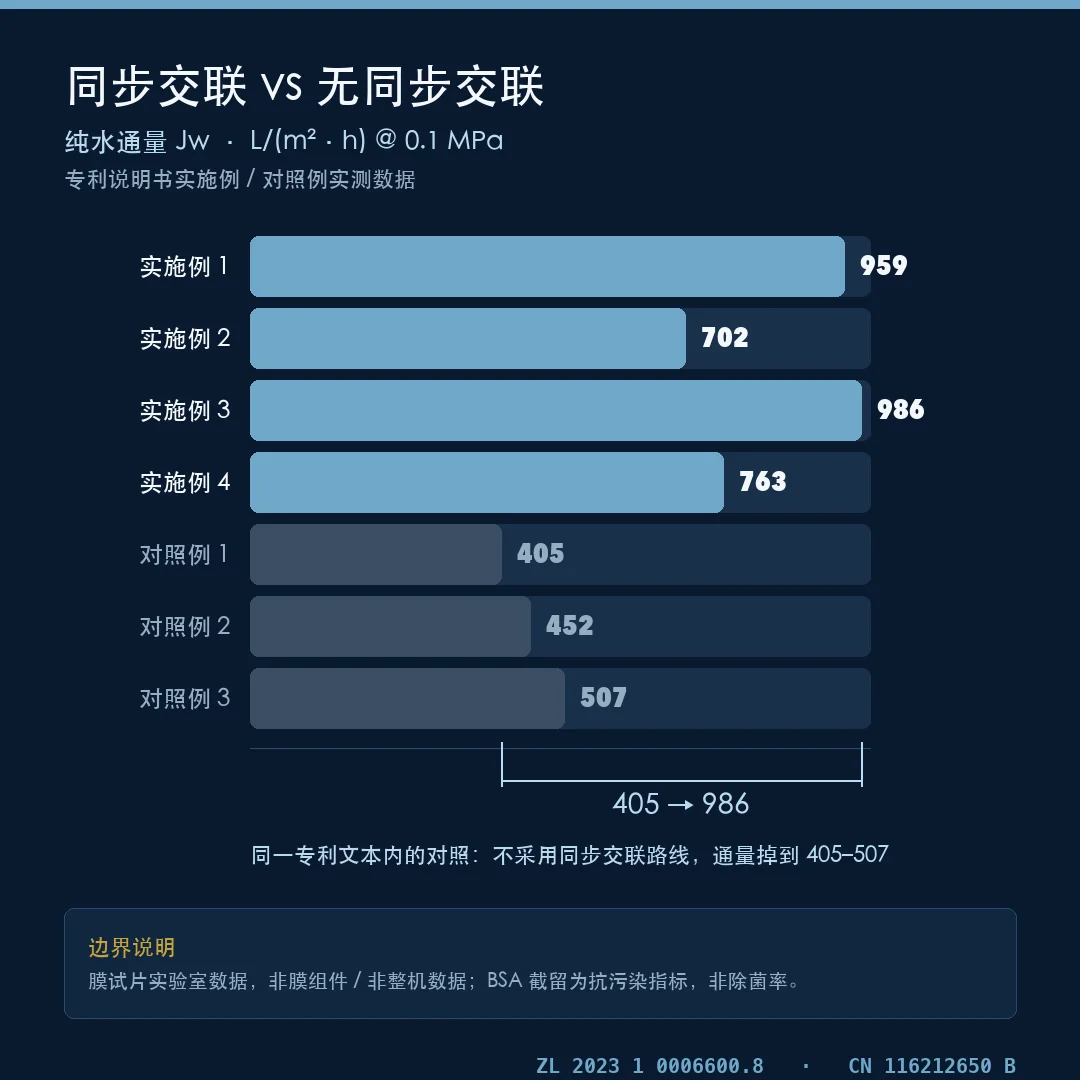
- Pure water flux at 0.1 MPa: 900–1000 L/(m²·h) across the examples, best example 986. Control examples without the simultaneous crosslinking step: 405–507.
- Water contact angle: 53–71° in the examples, against 70–75° in the controls.
- BSA rejection: up to 96%. Flux recovery ratio after a 10-minute rinse without pressure: 93%.
Two limits on those numbers, stated plainly:
- The 96% figure is bovine serum albumin rejection — an antifouling test marker. It is not a bacteria-removal claim, and we will not present it as one.
- These are laboratory measurements on flat-sheet coupons at 0.1 MPa from the patent specification. They do not convert into flow rates for any cartridge, housing or complete system we ship.
Scope, also stated plainly
This is a Chinese invention patent. It confers rights in China and nowhere else, and no overseas counterpart has been filed. We say so because "patented worldwide" is a phrase we cannot support, and buyers who check registers deserve the same answer we give them across a table.
What it changes for a purchaser: nothing today
No catalogue item moved. A patent protects a route, not a product line you can switch on. What does change is the standard of answer you are entitled to ask for: when a supplier says a membrane resists fouling, you can ask which mechanism, what it cost in flux, and whether anyone examined the evidence.
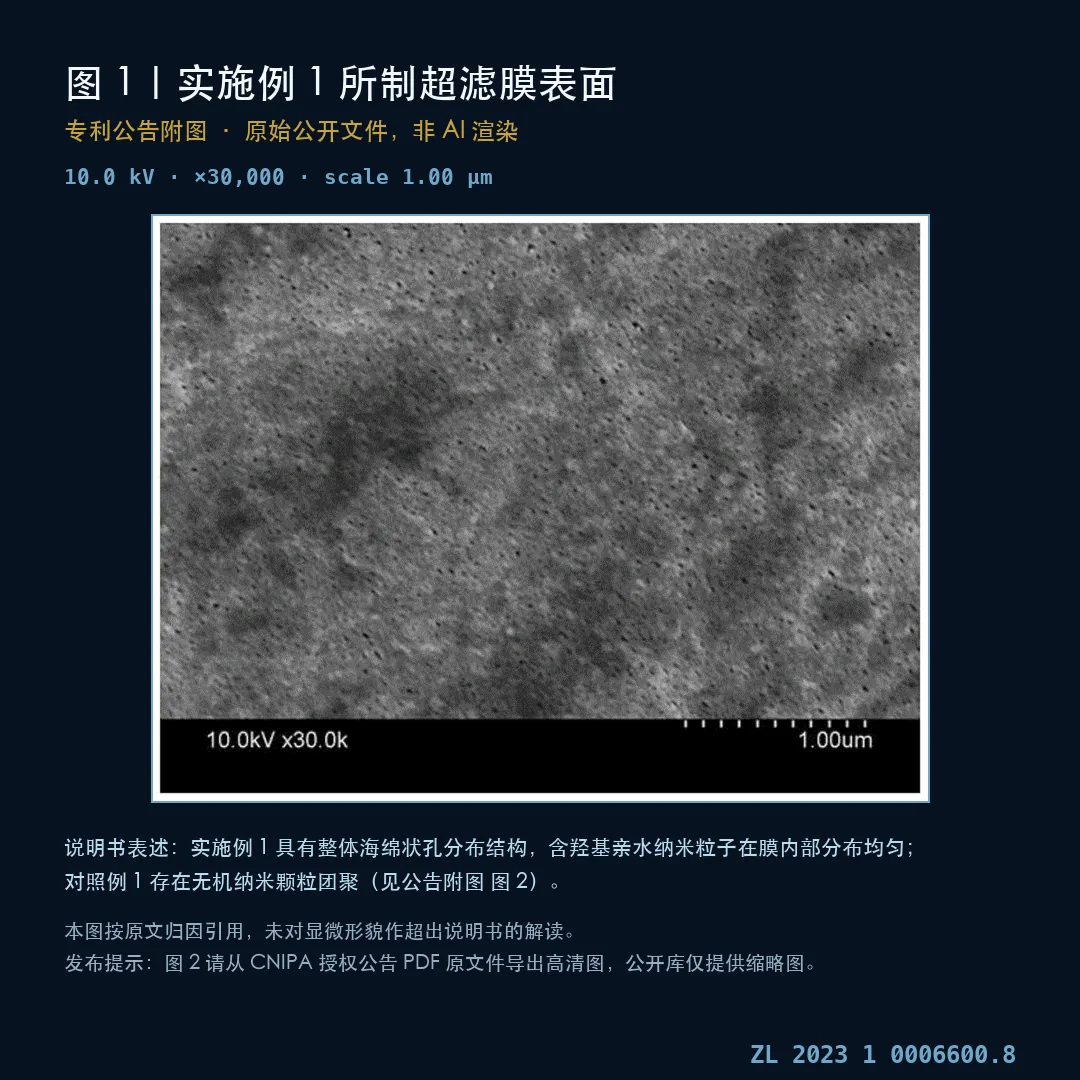
The specification’s electron micrographs show the contrast directly — uniform particle distribution in the examples, agglomerates in the control. If you are specifying antifouling performance against a particular water profile, send us the water. We will tell you what the membrane will and will not do.