
Ultrafiltration for Apartment Buildings and Property Management
Apartment blocks suffer from the same event repeatedly: a mains repair upstream sends sediment into the building, and every tenant sees discoloured water for a day. A central 0.01 micron barrier at the incoming main turns that from a building-wide complaint into a routine backwash, and protects the pressure set and heat exchangers while it does it.
Property managers rarely control the supply, but they own the consequences: complaints, flushing costs, and cleaning of scale and sediment from hot water systems. A central filter is one of the few interventions that addresses all three at the plant room rather than in each flat.
Where does it go in a residential block?
After the incoming main and meter, before the booster set and the hot water plant. That position catches sediment before it reaches pumps and exchangers, and lets one backwash drain handle the whole building.
Will tenants notice a difference?
They notice the absence of events: no brown water after mains work, no sediment in the washing machine filter, no chlorine smell in the shower. Steady improvement in taste is a secondary benefit where the supply is chlorinated heavily.
What about hardness and limescale?
Not addressed by ultrafiltration. If the building has a scaling problem in its hot water or heat exchangers, that is a softener or reverse osmosis decision taken separately - sizing a UF unit on a scale complaint is a common and expensive misunderstanding.
Typical configuration
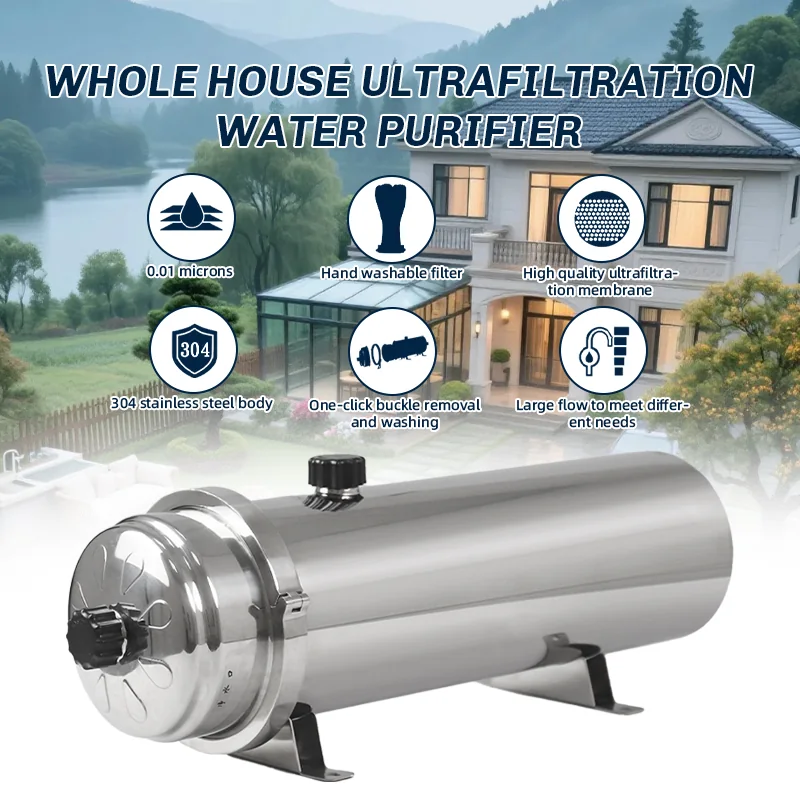
H-1 Whole-House UF Water Purifier
Horizontal whole-house ultrafiltration purifier in food-grade 304 stainless steel, with a uniform Φ168 mm cylinder and flow options from 3000 to 10000 L/h. PVDF or PVC membrane at 0.01 micron, no electricity required.
3,000-10,000 L/h · 304 stainless, washable, no power
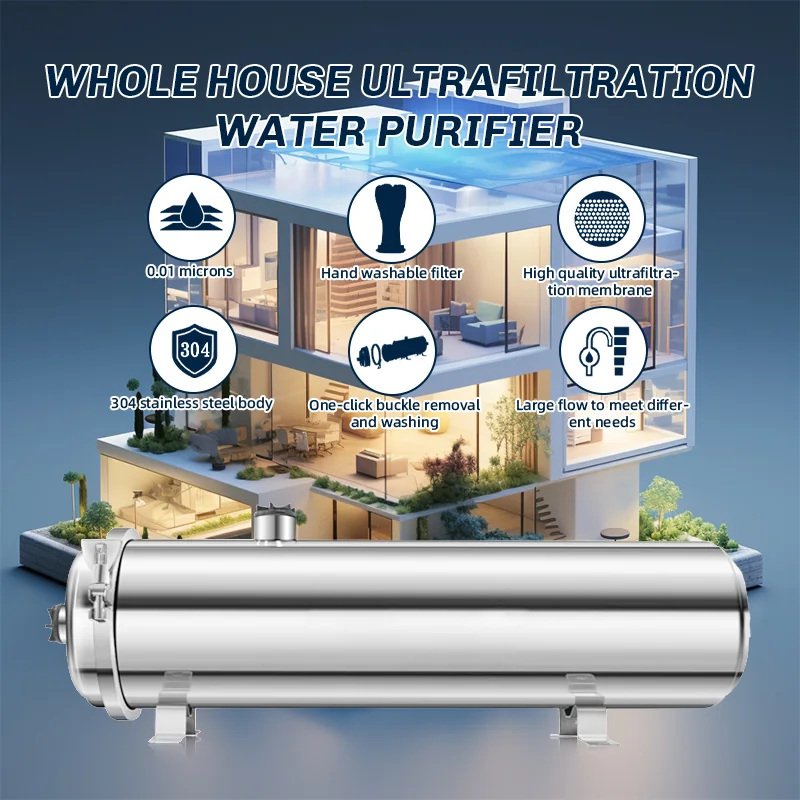
H-2 Whole-House / Commercial UF Water Purifier
Horizontal ultrafiltration purifier covering 1000 to 20000 L/h across three cylinder diameters (Φ102, Φ159, Φ203) for residential through commercial duty. Food-grade 304 stainless steel, PVDF or PVC membrane, 0.01 micron.
up to 20,000 L/h · Parallel modules for growth
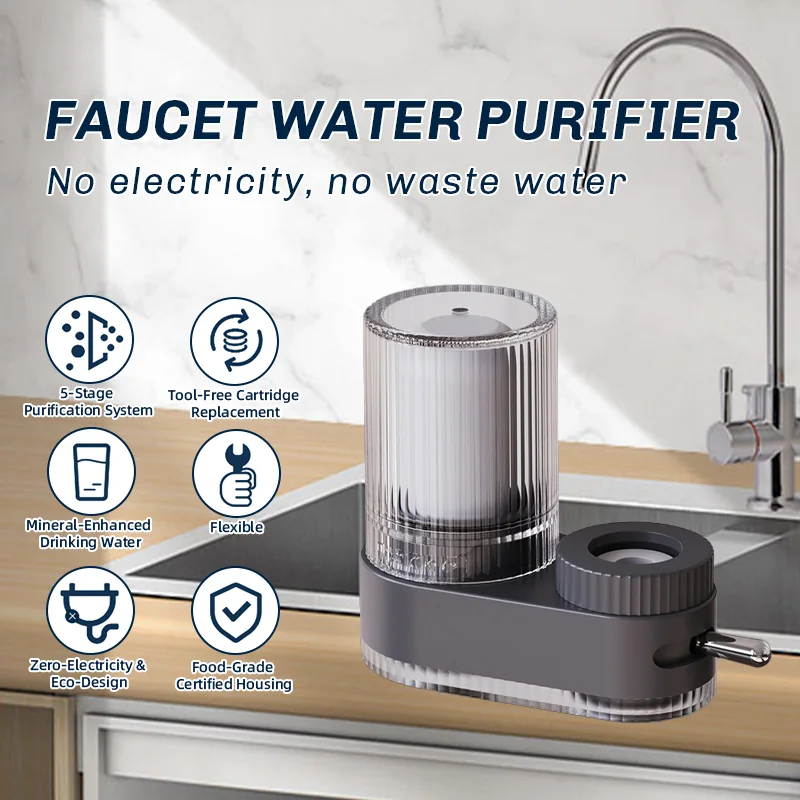
C-B2 Faucet-Mounted UF Water Purifier
Compact faucet-mounted purifier with a 304 stainless steel base and transparent housing. Cartridge options cover UF, carbon block, UF + CTO and ceramic composite, all at 0.01 micron and 1.5–2.0 L/min.
1.5-2.0 L/min · Where a tenant wants a final polish
Frequently asked questions
Does it need a pump?
No. The membrane works on line pressure from 0.1 MPa. If the building already has a booster set, the filter goes upstream of it so the pump is protected too.
How often does maintenance take place?
Backwash runs on a controller; element replacement happens every year or two depending on turbidity. Access to the plant room and a drain are the only site requirements.
Can it be fitted to an existing building?
Yes, on a bypass spool. A plant-room survey confirms pipe diameter, available pressure and drain position before the unit is specified.
Work out the numbers
Send the unit count, floors and incoming pipe size - we will specify the module and the bypass arrangement.