
Central Ultrafiltration for Hotels, Resorts and Guest Water
A single central ultrafiltration unit at the incoming main gives every guest outlet the same water quality: 0.01 micron hollow fibre removes turbidity, suspended solids and bacteria, and the stainless housing is backwashable in place rather than replaced. Hotels size the unit from peak occupancy demand, not average, because the worst hour decides whether the top floor still has pressure.
Guest complaints about hotel water are rarely about chemistry. They are about a brown tint after a mains repair, chlorine smell in the shower, or ice that clouds a drink. Those are particle and organics problems, and they are solved once at the plant room rather than per tap. A central unit also protects the expensive things downstream: laundry heat exchangers, coffee machines, ice makers and the boiler.
Where does a hotel put the UF unit?
On the incoming main after the break tank and booster set, before the softener if one is fitted. That position protects every downstream asset and lets one backwash drain serve the whole building. A point-of-use layer for drinking taps can stay in place behind it - the central unit reduces its load rather than replacing it.
How is capacity chosen when occupancy swings?
Size on peak-hour demand: rooms at full occupancy plus kitchens at service plus laundry in cycle. H-7 is offered in 2,000, 3,500 and 4,500 L/h grades and H-2 goes to 20,000 L/h, so a 200-room resort normally lands on the middle grade with a duty/standby pair. Sizing on the daily average is the most common mistake and shows up as pressure loss at breakfast.
What does it not fix?
Hardness and dissolved solids pass straight through. If the laundry or the espresso machines are scaling, the answer is a softener or reverse osmosis downstream, not a tighter UF element. Say so before the specification is written rather than after commissioning.
Typical configuration
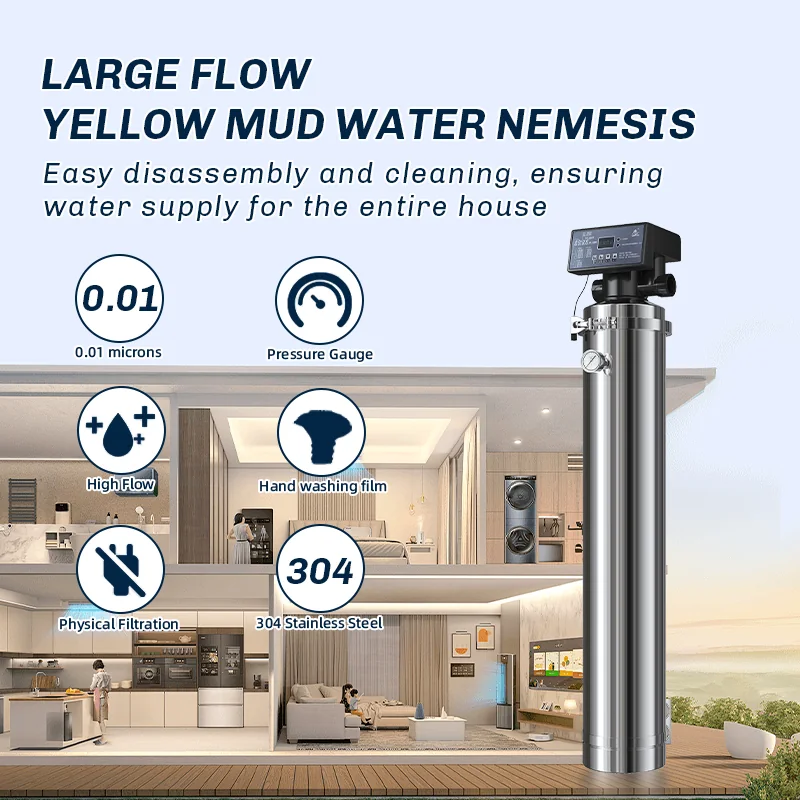
H-7 Central UF Water Purifier
Central whole-house ultrafiltration purifier in food-grade 304 stainless steel, with 2000 / 3500 / 4500 L/h options and matching Φ114 filter cores. 0.01 micron hollow fiber membrane, pressure-proof housing.
2,000 / 3,500 / 4,500 L/h · 304 stainless, washable element
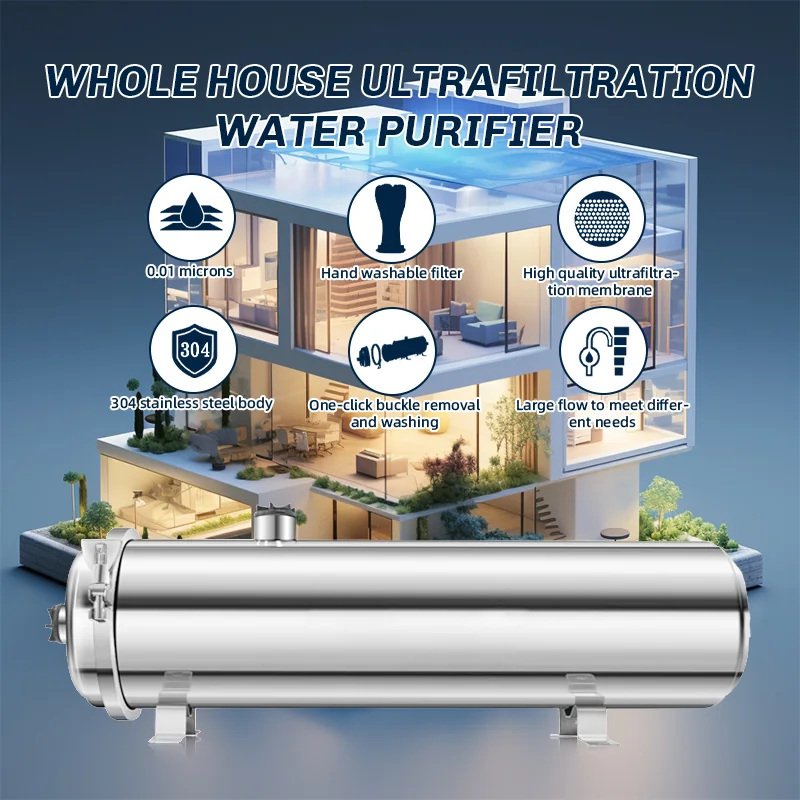
H-2 Whole-House / Commercial UF Water Purifier
Horizontal ultrafiltration purifier covering 1000 to 20000 L/h across three cylinder diameters (Φ102, Φ159, Φ203) for residential through commercial duty. Food-grade 304 stainless steel, PVDF or PVC membrane, 0.01 micron.
up to 20,000 L/h · Banked pairs for duty/standby
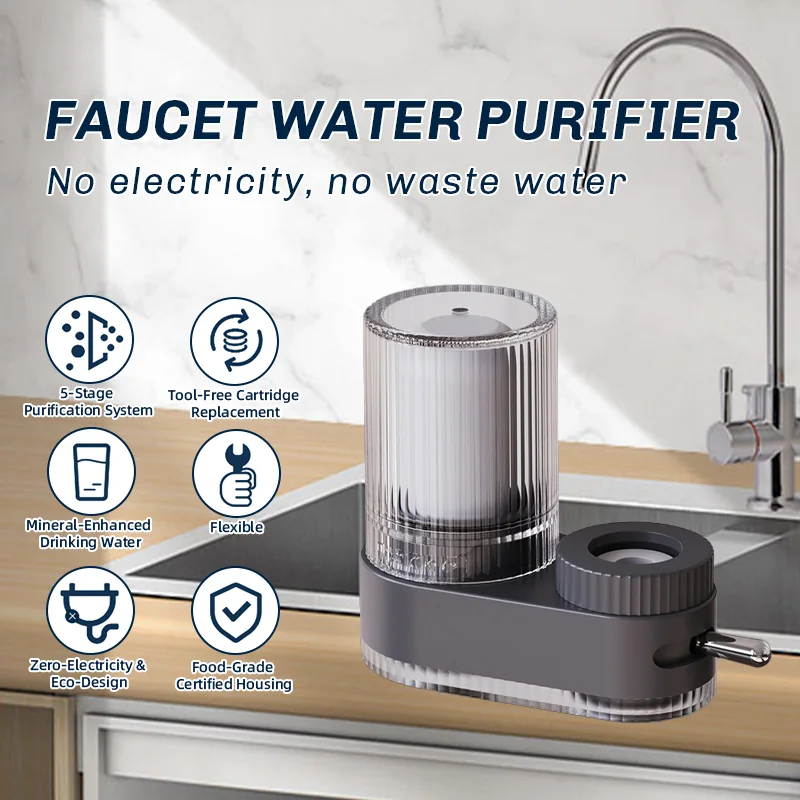
C-B2 Faucet-Mounted UF Water Purifier
Compact faucet-mounted purifier with a 304 stainless steel base and transparent housing. Cartridge options cover UF, carbon block, UF + CTO and ceramic composite, all at 0.01 micron and 1.5–2.0 L/min.
1.5-2.0 L/min · Optional final polish at the tap
Frequently asked questions
Will one unit serve both the kitchen and the guest rooms?
Yes, if it is sized on the combined peak. Kitchens draw hard for short periods and rooms draw steadily; the peak hour is the sum of both, which is why the daily average understates the requirement.
Does the element have to be replaced when it clogs?
No. The element is washed and backflushed in place; replacement is periodic, not on every clogging event. Budget the element as a consumable with an interval set by your turbidity, and use the running cost calculator to price it.
Can it run during a power cut?
The membrane stage needs no power - it works on line pressure from 0.1 MPa. Backwash control and any booster pump do need power, so keep the unit on the essential circuit if continuity matters.
Work out the numbers
Send room count, peak occupancy and your latest water analysis - we will return a capacity, a grade and a backwash arrangement.