
Water Filtration for Espresso Machines and Cafés
Espresso needs two different things removed for two different reasons: chlorine and organics for taste, and hardness for the boiler. Ultrafiltration with a carbon block handles the first at 0.01 micron; the second needs ion exchange or reverse osmosis. A café that only filters particles will still scale its boiler, and a café that only softens will still taste the chlorine.
A commercial espresso machine is a heat exchanger full of narrow passages. Scale insulates the element, raises recovery time and eventually blocks the group. Chlorine attacks seals and leaves a medicinal note in the cup. Both problems are cheap to prevent at the water inlet and expensive to fix at the bench.
What does the filter actually have to remove?
Three things: particulate that abrades pumps and valves, chlorine and organics that flatten flavour, and hardness that scales the boiler. Stages one and two are filtration and adsorption; the third is chemistry. Sizing a café on filtration alone is a half-solution.
Which configuration suits a small café?
A ZH-B three-stage system at 350 L/h under the counter, feeding the espresso machine and the rinse tap, covers a typical single-group or two-group bar. Where cabinet space is the constraint, C-B2 mounts directly on the faucet at 1.5-2.0 L/min and needs no plumbing work.
How do I know the element is spent?
Flow drop at the group is the practical signal: when extraction pressure sags and the pump runs longer, the element is loading. A pressure gauge either side of the housing turns that from a guess into a reading. Change on differential, not on a calendar you never check.
Typical configuration
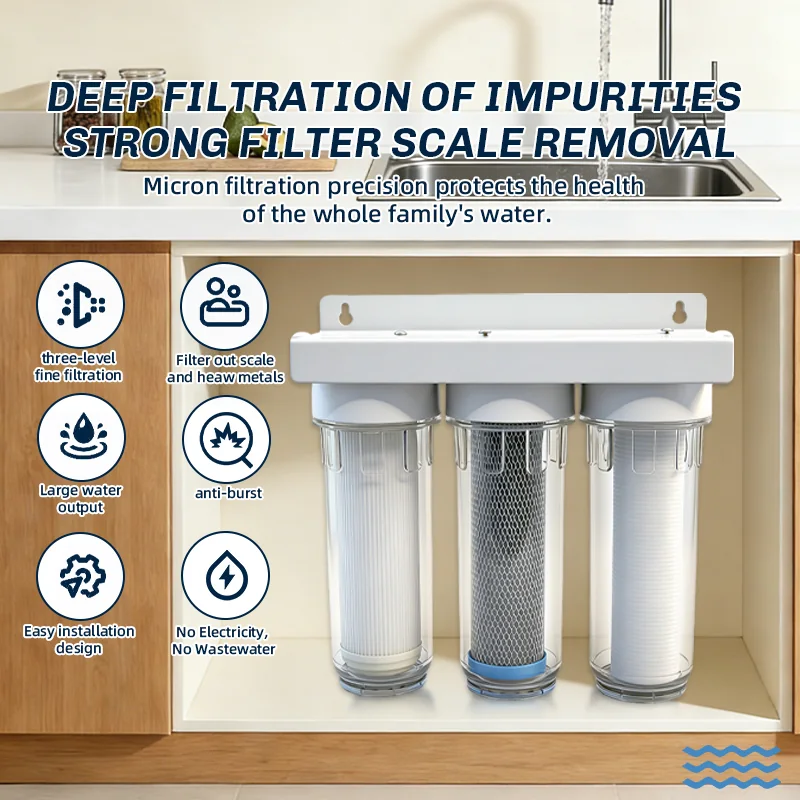
ZH-B 3-Stage Transparent Under-Sink UF System
Three-stage under-sink system with transparent reinforced housings: PP cotton, carbon block and a hollow fiber UF membrane at 350 L/h. The clear housing lets an end user see cartridge condition without opening the unit.
350 L/h · PP + carbon block + 0.01 micron UF
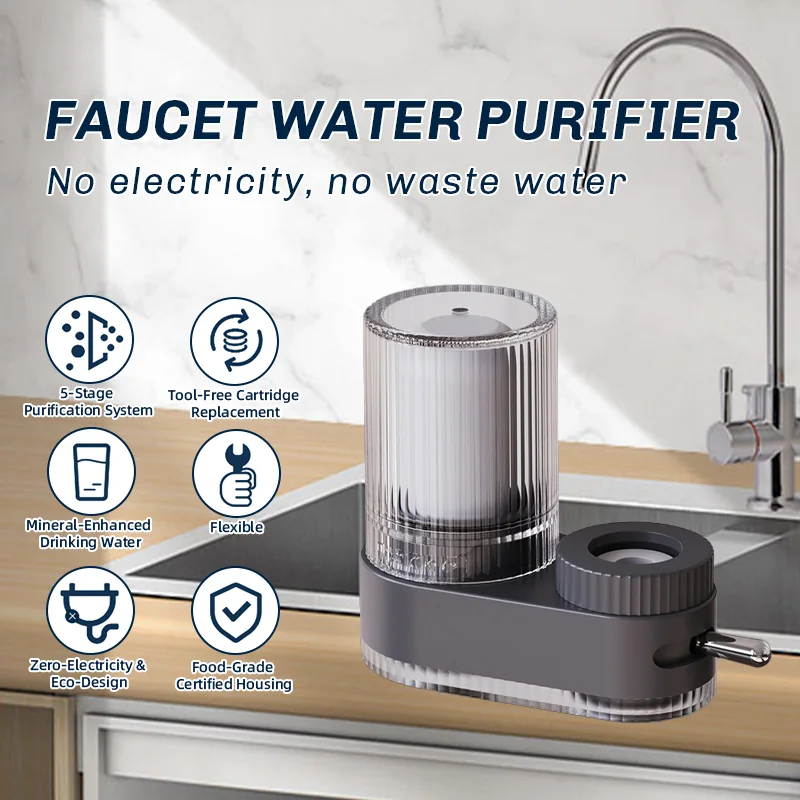
C-B2 Faucet-Mounted UF Water Purifier
Compact faucet-mounted purifier with a 304 stainless steel base and transparent housing. Cartridge options cover UF, carbon block, UF + CTO and ceramic composite, all at 0.01 micron and 1.5–2.0 L/min.
1.5-2.0 L/min · 304 stainless base
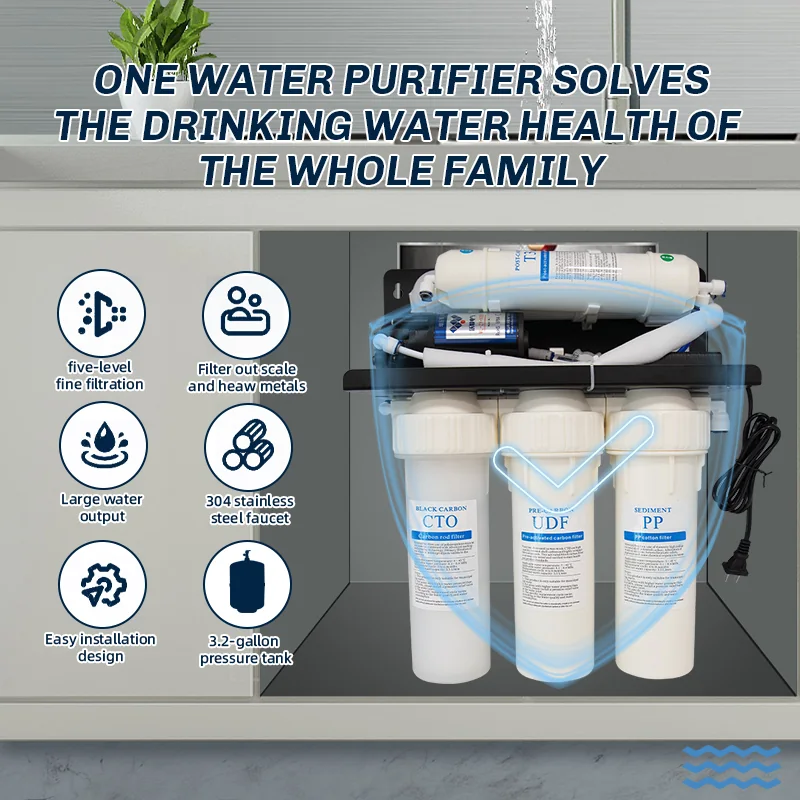
R-A1 5-Stage RO System 100 GPD
Five-stage reverse osmosis system with booster pump: PP, UDF, CTO, a 100 GPD RO membrane and T33 post-carbon, rated 45 W at 200 V / 50 Hz. Modular interchangeable cartridges and a 400 × 180 × 465 mm under-sink footprint.
- · Hardness is not removed by UF
Frequently asked questions
Will a UF filter remove the scale that damages my boiler?
No. Scale is dissolved calcium and magnesium; ultrafiltration works on particles and does not remove dissolved minerals. Use a softener or reverse osmosis for hardness, and keep the UF stage for particles and chlorine.
Can I run the espresso machine and the rinse tap from one unit?
Yes, if the unit is sized for the sum of both draws. ZH-B at 350 L/h leaves ample margin for a two-group machine plus a rinse tap.
How often should the cartridge change?
On differential pressure or flow loss, not on a fixed schedule. Use the running cost calculator to see what a given interval costs per year at your daily volume.
Work out the numbers
Tell us your machine model, group count and water hardness - we will recommend a filtration and scale-control pairing.