
Ultrafiltration for Bottling and Packaged Drinking Water
In a bottled water line the UF stage sits between pretreatment and disinfection, holding turbidity and particle load steady so the ozonation or UV dose does what it is designed to do. A 0.01 micron hollow fibre barrier also keeps the fill valves and caps free of the fines that cause visible specks in a clear bottle.
Packaged water is judged by eye before it is judged by the lab. A single visible particle in a clear PET bottle costs a pallet. Most of those particles come from the treatment train itself - carbon fines, resin fragments, filter debris - which is why plants put a final barrier immediately before filling rather than trusting an earlier stage.
Where in the train does UF belong?
After carbon and softener, before the disinfection step and the filling block. Carbon beds shed fines; a UF stage downstream of them catches what the bed releases. Putting UF before carbon wastes the element on organics that carbon would have adsorbed, and shortens its interval for no benefit.
How does UF interact with ozonation and UV?
UF removes the particles that shield microorganisms from UV and the turbidity that consumes ozone. It does not replace either step: it makes their performance predictable by keeping the feed consistent. Plants that fight drifting UV transmittance usually find the cause upstream in the particle load.
Can the same skid handle a recipe change?
Mineral dosing changes the chemistry, not the particle load, so the UF stage is unaffected. Where the plant switches between spring water and treated municipal feed, size for the dirtier source and let the cleaner one run longer between washes.
Typical configuration
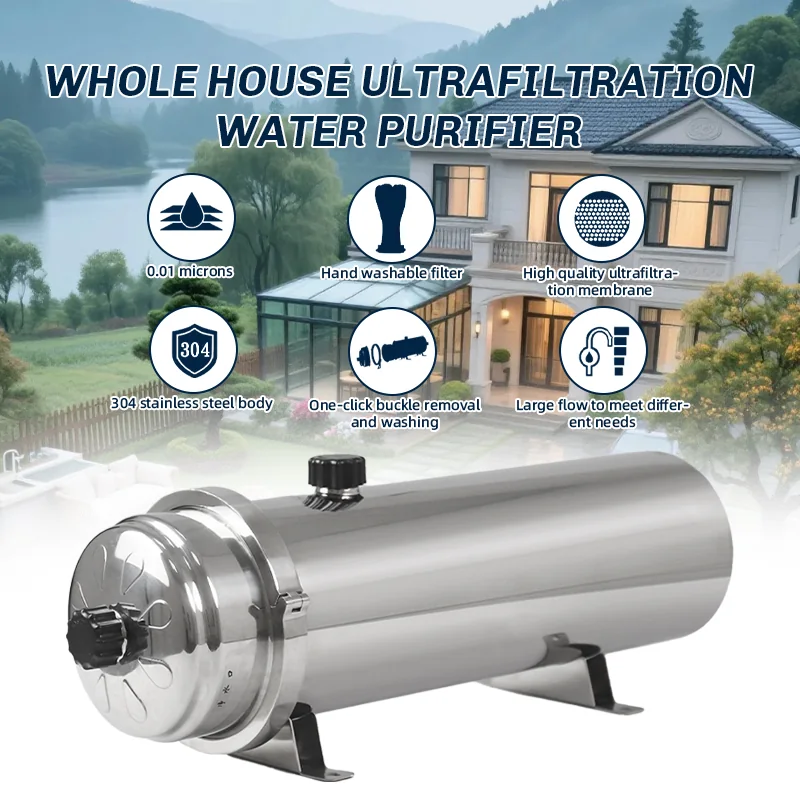
H-1 Whole-House UF Water Purifier
Horizontal whole-house ultrafiltration purifier in food-grade 304 stainless steel, with a uniform Φ168 mm cylinder and flow options from 3000 to 10000 L/h. PVDF or PVC membrane at 0.01 micron, no electricity required.
- · Organics and chlorine removal
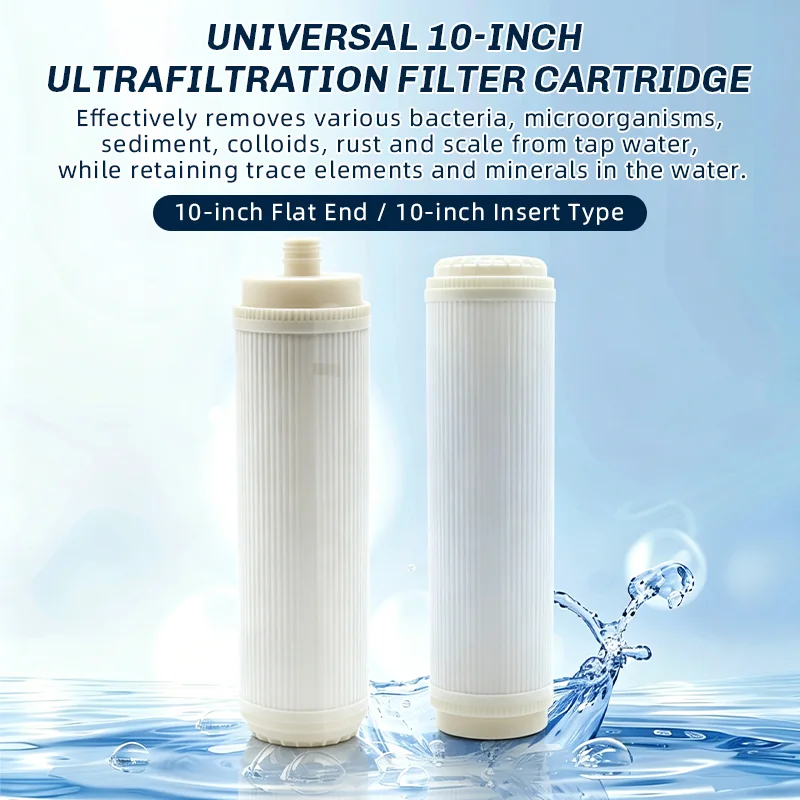
LX-A1 Universal 10-Inch UF Membrane Element
Universal 10-inch hollow fiber UF element, Φ70 × 254 mm, in PS, PVDF or PES at 0.01 micron. Fits standard 10-inch housings and replaces the cartridge in existing under-sink systems.
3,000 / 5,000 / 8,000 / 10,000 L/h · 0.01 micron, 304 stainless, washable
Frequently asked questions
Does UF remove the minerals that give the water its taste?
No. Dissolved minerals pass through, which is usually what a spring water brand wants. If the specification calls for demineralised water, that is a reverse osmosis job downstream of the UF stage.
How often does the element need replacing?
The interval follows feed turbidity and the volume pushed through it, not a fixed calendar. Track pressure differential across the element: a rising differential that no longer recovers after backwash is the signal, well before any quality result moves.
Is the housing suitable for CIP?
The 304 stainless housing and hollow fibre element tolerate standard clean-in-place chemicals at the concentrations used in beverage plants. Confirm the specific agents and temperatures with us before writing the CIP recipe.
Work out the numbers
Send your line capacity, source water and existing train - we will place the UF stage and specify the housing.