
Ultrafiltration for Aquaculture and Hatchery Water
Hatchery water problems are usually about what arrives with the water: silt after rain, algae and the organisms that graze on them, and the organic load that consumes oxygen as it decays. A 0.01 micron barrier on make-up water removes that load before it enters the system, and does it without adding anything to the water.
Recirculating systems concentrate whatever enters them. That makes make-up water quality disproportionately important: a small turbidity spike becomes a biofilter load, then a dissolved oxygen problem, then a mortality event that looks like disease.
What does UF remove from make-up water?
Suspended solids, turbidity, algae and organism-sized particles down to 0.01 micron. It does not remove dissolved nutrients, ammonia, nitrate, pesticides or metals - those need biological treatment, ion exchange or reverse osmosis depending on the parameter.
How is capacity matched to a farm?
From make-up rate, not system volume. A farm replacing a few percent of its volume daily needs a small unit; a flow-through hatchery needs thousands of litres per hour. H-1 covers 3,000 to 10,000 L/h, H-2 extends to 20,000 L/h.
Does the filtering harm the water chemistry?
No. It is a physical barrier with no dosing and no media that shifts pH. That is the main argument for UF in a system where any chemical change is a risk to stock.
Typical configuration
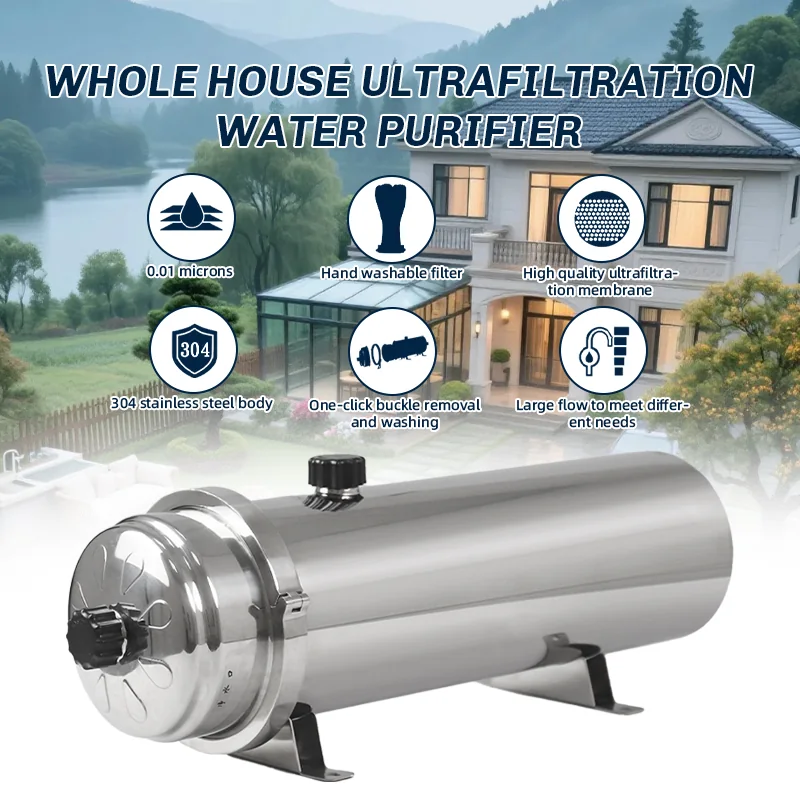
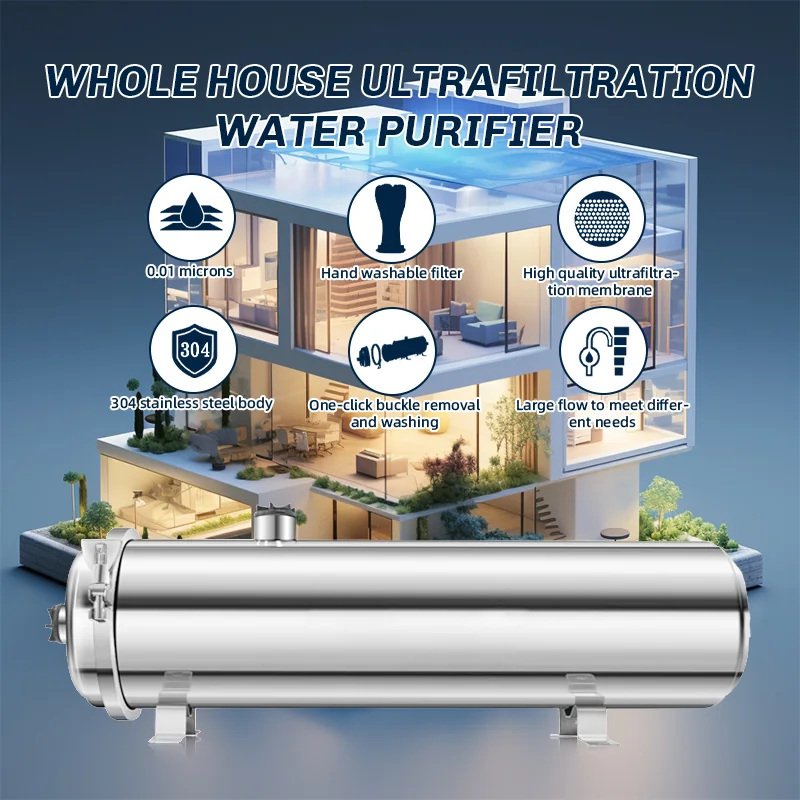
H-1 Whole-House UF Water Purifier
Horizontal whole-house ultrafiltration purifier in food-grade 304 stainless steel, with a uniform Φ168 mm cylinder and flow options from 3000 to 10000 L/h. PVDF or PVC membrane at 0.01 micron, no electricity required.
3,000-10,000 L/h · Washable, no chemicals
H-2 Whole-House / Commercial UF Water Purifier
Horizontal ultrafiltration purifier covering 1000 to 20000 L/h across three cylinder diameters (Φ102, Φ159, Φ203) for residential through commercial duty. Food-grade 304 stainless steel, PVDF or PVC membrane, 0.01 micron.
up to 20,000 L/h · Parallel banks
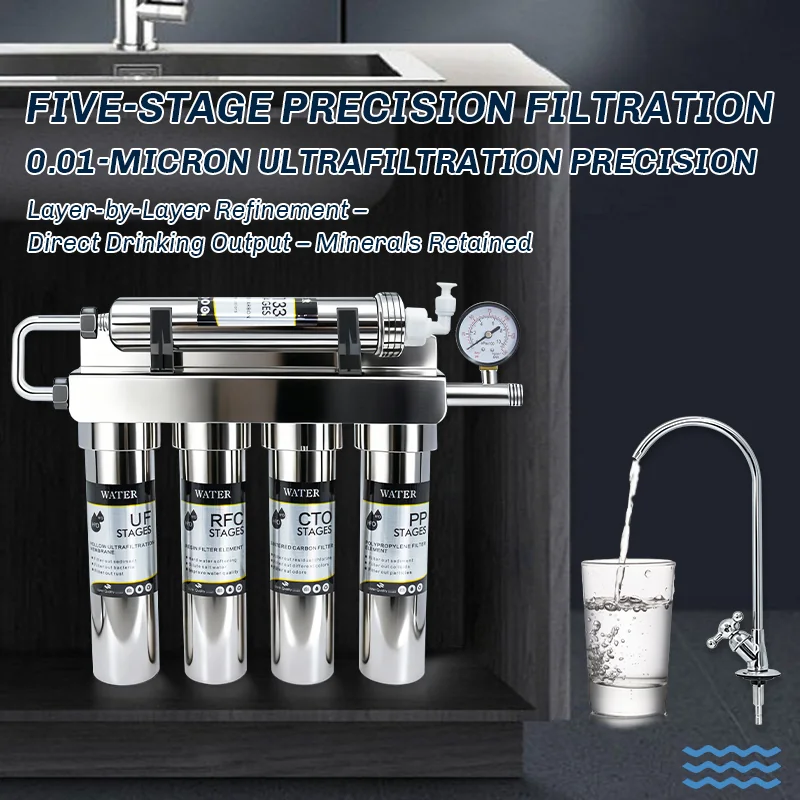
ZH-A 5-Stage Stainless Steel UF System
Wall-mounted or under-sink five-stage ultrafiltration system in a 304 stainless steel body. PP, RFC, CTO, UF and T33 cartridges run in series at 0.01 micron and 220 L/h, with a pressure gauge and interchangeable cartridges.
220 L/h · For lab and quarantine rooms
Frequently asked questions
Will it remove parasites and pathogens from the water?
A 0.01 micron barrier holds back organism-sized particles, which reduces the load entering the system. It is not a validated sterilisation step and does not replace biosecurity practice.
Can it handle seawater?
The stainless housing tolerates seawater service. Confirm the fitting material with us - mixed metals are the usual corrosion failure in marine aquaculture.
What happens during an algae bloom?
The element loads quickly. Shorten the backwash interval, or pre-screen with a coarser stage so the UF element is not asked to store the whole bloom.
Work out the numbers
Send make-up rate, salinity and target species - we will size the module and the backwash arrangement.