
Ultrafiltration for Rural and Community Water Points
A community water point has to work with what is available: gravity head, intermittent supply, and no chemist on site. Ultrafiltration fits that constraint because the barrier is physical and the element is washed rather than regenerated - no dosing pump to fail and no salt to restock.
Small supplies fail for operational reasons more often than technical ones: a dosing pump runs dry, a media bed is never backwashed, a spare part is six weeks away. The attraction of a washable hollow fibre module is that maintenance is something a caretaker can do with a brush and a bucket.
Can it run without electricity?
The membrane stage can: it operates on inlet pressure from 0.1 MPa, which a raised tank provides. Automated backwash control needs power, so sites without it use manual backwash valves - slower, but it removes a failure mode.
What does it protect in a village supply?
The distribution line and the storage tank from the sediment that enters after rain, and consumers from the turbidity that follows any disturbance upstream. It does not replace disinfection or source protection, which remain the primary safeguards.
How is it sized for a settlement?
From the number of households and the hours the point operates, with a margin for simultaneous draw. H-1 at 3,000 L/h covers a large settlement point; H-7 at 2,000 L/h suits a smaller one where demand is steady.
Typical configuration
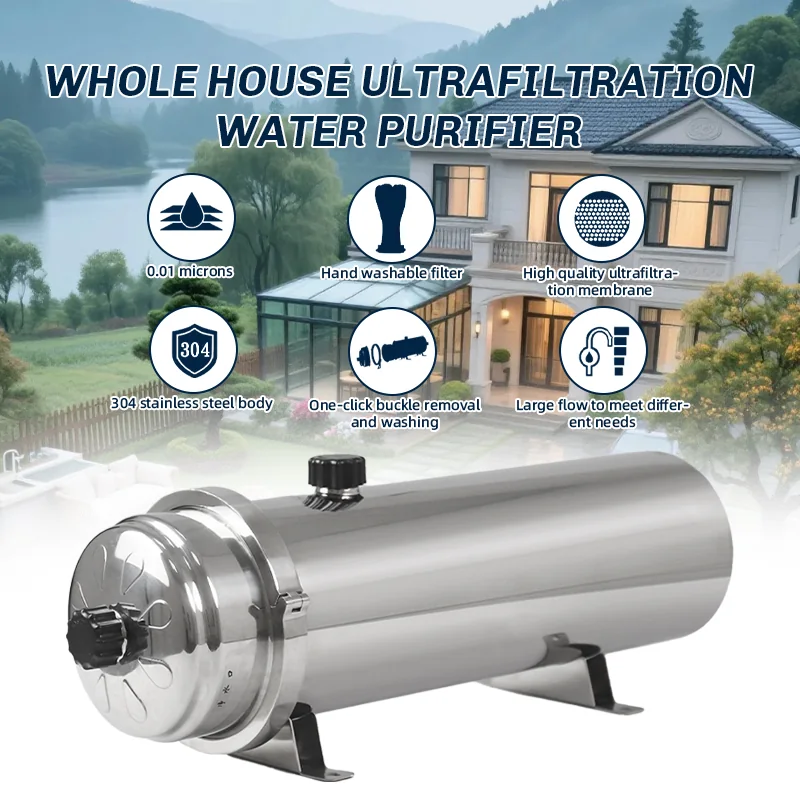
H-1 Whole-House UF Water Purifier
Horizontal whole-house ultrafiltration purifier in food-grade 304 stainless steel, with a uniform Φ168 mm cylinder and flow options from 3000 to 10000 L/h. PVDF or PVC membrane at 0.01 micron, no electricity required.
3,000-10,000 L/h · Gravity or line pressure, washable
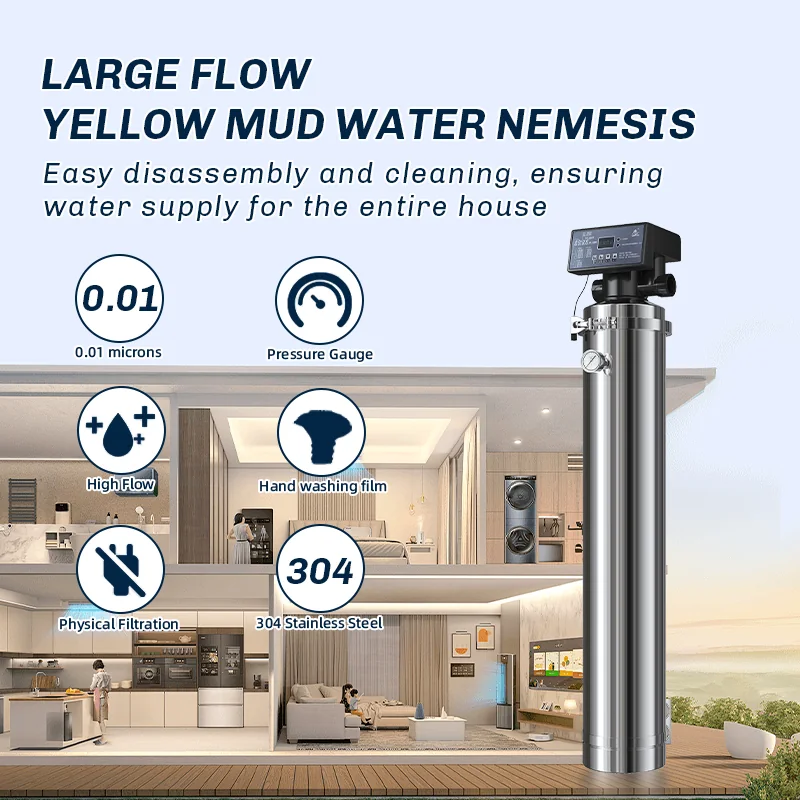
H-7 Central UF Water Purifier
Central whole-house ultrafiltration purifier in food-grade 304 stainless steel, with 2000 / 3500 / 4500 L/h options and matching Φ114 filter cores. 0.01 micron hollow fiber membrane, pressure-proof housing.
2,000 L/h · Compact stainless housing
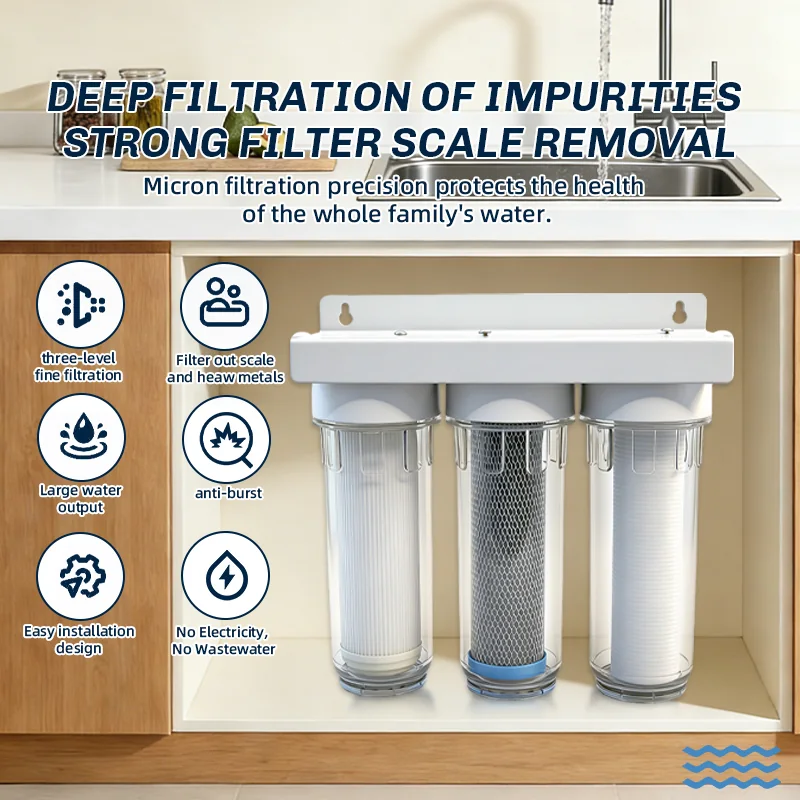
ZH-B 3-Stage Transparent Under-Sink UF System
Three-stage under-sink system with transparent reinforced housings: PP cotton, carbon block and a hollow fiber UF membrane at 350 L/h. The clear housing lets an end user see cartridge condition without opening the unit.
350 L/h · Where piped supply reaches homes
Frequently asked questions
Does it need chemicals?
The filtration step needs none. Where the source is not microbiologically safe, disinfection is a separate requirement - filtration reduces particle load but is not a disinfection process.
How often does the element need cleaning?
On surface water, weekly backwash with a periodic brush clean is typical; municipal-quality feed can go far longer. Base the interval on pressure differential, not on habit.
What spare parts should be held on site?
One spare element and a set of seals. Everything else is passive stainless hardware, which is the point of the design.
Work out the numbers
Tell us household count, source type and available head - we will specify the module and the manual backwash arrangement.