
Treating Well and Bore Water for a House
Bore water usually carries two kinds of problem: particles (sand, clay, rust flakes) and dissolved metals (iron, manganese) that stain and taste. A five-stage system with a 0.01 micron element removes the particles and the taste compounds; dissolved iron needs oxidation and filtration upstream, or the element simply loads faster than it should.
Well water is not one water. Two bores a kilometre apart can need different treatment, which is why any honest recommendation starts with an analysis rather than a model number. What is consistent is the failure pattern: the first stage takes the punishment, and the owner blames the filter when the real issue is untreated iron.
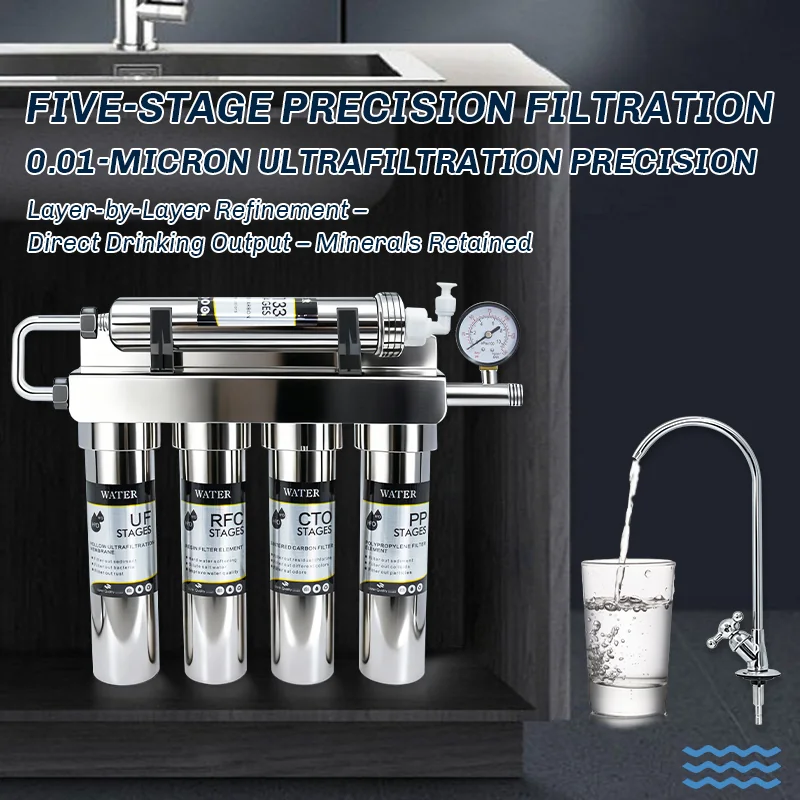
What does a five-stage system remove from bore water?
Sand, clay, rust particles, turbidity, chlorine and organic taste compounds, plus bacteria-sized contaminants at the 0.01 micron barrier. It does not remove dissolved iron or manganese, hardness, nitrate or salinity - each of those needs its own process step.
Why does the pre-filter clog so fast?
Because it is doing the work that an iron removal stage should be doing. On water with visible iron, oxidise and settle upstream first, then filter. Otherwise the PP stage becomes a weekly consumable and the owner concludes that filtration does not work.
When does a house need reverse osmosis instead?
When the problem is dissolved: hardness, nitrate, salinity or metals in solution. R-A1 handles that at 100 GPD with a 45 W pump, but it sends a share of the feed water to drain, so it is a drinking-water solution rather than a whole-house one.
Typical configuration
ZH-A 5-Stage Stainless Steel UF System
Wall-mounted or under-sink five-stage ultrafiltration system in a 304 stainless steel body. PP, RFC, CTO, UF and T33 cartridges run in series at 0.01 micron and 220 L/h, with a pressure gauge and interchangeable cartridges.
220 L/h · PP + RFC + carbon + UF + T33
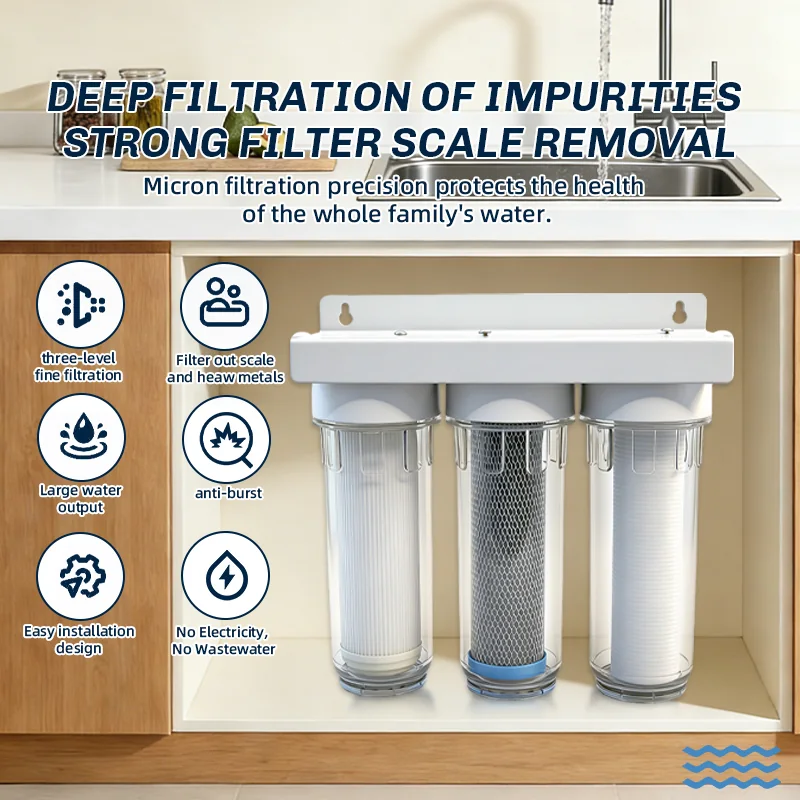
ZH-B 3-Stage Transparent Under-Sink UF System
Three-stage under-sink system with transparent reinforced housings: PP cotton, carbon block and a hollow fiber UF membrane at 350 L/h. The clear housing lets an end user see cartridge condition without opening the unit.
350 L/h · Simple three-stage
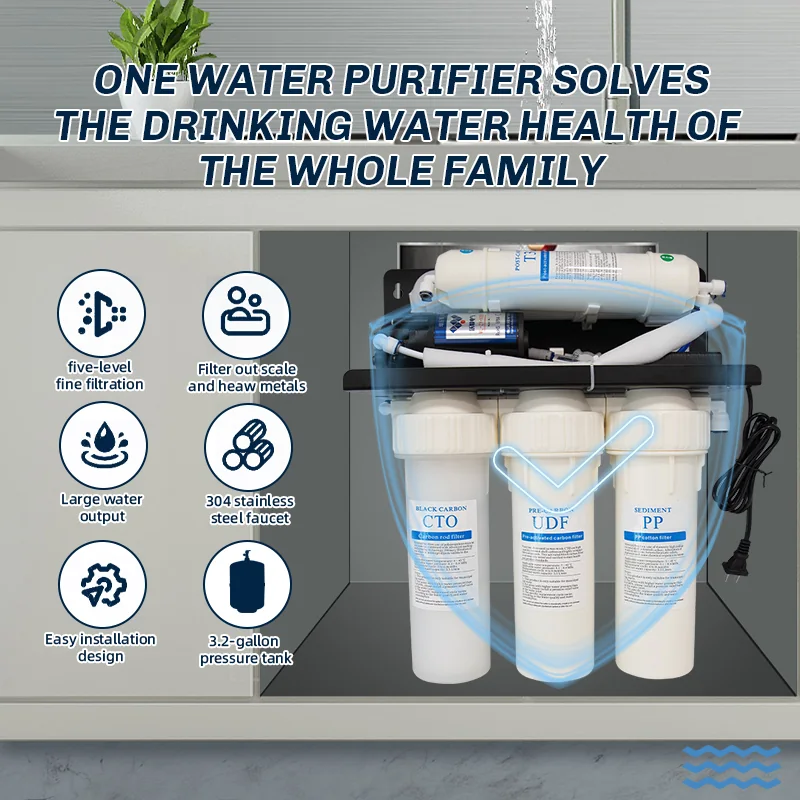
R-A1 5-Stage RO System 100 GPD
Five-stage reverse osmosis system with booster pump: PP, UDF, CTO, a 100 GPD RO membrane and T33 post-carbon, rated 45 W at 200 V / 50 Hz. Modular interchangeable cartridges and a 400 × 180 × 465 mm under-sink footprint.
100 GPD · 45 W booster pump required
Frequently asked questions
Can I filter bore water without testing it?
You can, but you will replace elements more often than necessary. A basic analysis for iron, manganese, hardness, turbidity and nitrate costs little and decides the whole treatment train.
Does the filter make bore water safe to drink?
It removes particles and bacteria-sized contaminants. Whether the water is potable depends on chemistry and on microbiology, which is a laboratory question, not a filter specification.
Why does the water taste metallic even after filtering?
Dissolved iron passes through a 0.01 micron membrane. Taste from dissolved metals needs oxidation and removal upstream, not a tighter element.
Work out the numbers
Send your water analysis - iron, manganese, hardness and turbidity are the four numbers that decide the train.